
What do we actually know about the impacts of AI on our minds?
Research is slow. Signals are real. A field report and my 3 cents.

When it comes to the impact of generative artificial intelligence on our minds, there’s a lot of noise right now. Panic on one side (“AI is making us stupid”) and dismissal on the other (“That’s just technophobia”). Neither is useful. A rigorous paper takes up to 24 months from study to publication, while the technology moves in weeks and the hype in days. This gap is not a reason to dismiss the signals; it’s a reason to take them more seriously.
Let's separate the research, the slow and rigorous kind, from the signals: what I'm observing and hearing in real time. I'll close with the questions I'm sitting with today. Both come from the same source: ongoing, global 1:1 conversations with leaders and the Tandem dinners I co-curate and host, where AI leaders, practitioners, researchers, and thinkers compare notes on what's actually happening.
What research shows today
Productivity gains are real. So are second-order impacts.
The numbers are clear when it comes to speed, as shown in three studies.
A controlled study with 95 freelance developers found that GitHub Copilot cut completion time by 55.8% on a standard coding task. A field experiment from Wharton with 758 BCG consultants found that on tasks within AI’s current ability, people completed 12% more tasks and finished 25% faster, with higher-quality output. At P&G, individuals working with AI matched the solution quality of two-person teams that didn’t use it, calling AI a “Cybernetic Teammate”.
The same studies revealed a limit: the same BCG consultants, given a task outside AI’s ability, were 19 points less likely to land on the correct answer than consultants working without AI at all. The model sounded just as confident either way. Speed goes up. Depth goes down. Researchers call this the “jagged frontier”: exceptional on familiar terrain. Unreliable at the edges, with no signal to tell you when you’ve crossed over.
Retention is the cost that shows up later.
A randomized trial with developers learning a new programming library found that using AI cut comprehension quiz scores by 17%, with no net time savings. The reading and prompting time canceled out the speed gained from the generated code. A separate trial with 120 students gave a surprise test 45 days after the original session. Students who’d learned the material the traditional way scored 68.5%. Students who’d used ChatGPT scored 57.5%, even after accounting for the fact that they’d spent less time studying. Both studies point to the same mechanism: the friction AI removes is often the friction that makes things stick (also called “productive struggle” for education experts).
Confidence increases regardless of accuracy.
A Wharton study with 1,372 participants found that people who consulted an AI assistant gained 25 points in accuracy when it was right and lost 15 points when it was wrong, yet they reported feeling more confident either way. Building on Daniel Kahneman’s System 1 (fast intuition) and System 2 (slow, deliberate reasoning), they introduced a “System 3”, an artificial cognition sitting outside our brain. Yet what happens when the AI’s perception in this System 3 makes people stop thinking for themselves? The researchers call this cognitive surrender: the feeling of competence and actual competence come apart. One trusts the output because it sounds right, not because they verified it.
Cognitive surrender is different from cognitive offloading.
Cognitive offloading is rational. The calculator or the GPS are often pulled out as an illustration of what is taken off your cognitive plate: you delegate a task you don’t need to do yourself (eg a complex multiplication or the detailed itinerary across cities). Surrender is something deeper. You stop thinking because the answer seems convincing enough. You don’t dare push back anymore; the machine’s confidence and reasoning become yours and the lines get blurred.
“Falling asleep at the wheel” is a documented phenomenon.
A Harvard field experiment illustrates this clearly: 181 professional recruiters are given AI tools of different quality levels (“Perfect”, “Good” and “Bad”). The recruiters were randomly paired with the best AI did worse than the ones paired with mediocre AI. Why? The better the AI, the more likely they were to stop checking its picks and rubber-stamp them. When it looked unreliable, they stayed alert and kept improving. The most experienced recruiters were hit hardest: their judgment paid off against bad AI and went dormant in front of good AI.
An MIT Media Lab (early) study put this under EEG. 54 students wrote essays with ChatGPT, with a search engine or with no tool at all. The ChatGPT group showed the weakest brain connectivity of the three and the hardest time quoting their own essays minutes later. When the tool was taken away in a later session, that group could not bounce back to a clean baseline. Skill erodes from lack of practice over time.
AI is impacting how we relate and treat each other.
Anthropic’s own analysis of 1.5 million Claude conversations found the assistant validating persecution narratives and labeling third parties “toxic” or “abusive” based on one-sided accounts, and in some cases scripting entire personal messages that users then sent to other people, unedited. Severe cases are rare, under 1 in 1,000 conversations, but they cluster in exactly the relationships and decisions where independent judgment matters most. Disempowering responses got rated higher by users than the alternative: a real tension between what people like and what serves them.
A Stanford study across 11 AI models found they affirm users’ actions 50% more often than humans do, even when the user describes manipulation, deception, or other relational harm. In a live conflict-discussion experiment with over 1,600 participants, talking to a sycophantic AI cut people’s willingness to repair the conflict and raised their conviction that they were right. The same participants rated the sycophantic AI as higher quality and said they’d use it again. The flattery that erodes judgment is the same flattery that keeps people coming back.
Practitioners’ signals are worth acknowledging
These signals aren’t peer-reviewed yet, but they’re consistent across dozens of conversations with leaders, researchers, and practitioners. I’ll use anonymous quotes to illustrate these:
The responsibility gap.
AI produces work that looks convincing enough to pass along without review. The original creator loses track of what they actually contributed. The colleague receiving it ends up doing the evaluation work instead, a hidden transfer of cognitive labour that doesn’t show up in any productivity metric (although we know 40% of knowledge workers are impacted by “workslop”).
“The presentations combined multiple group inputs and made no sense. But they looked professional.” (Head of AI deployment, 1200 people)
“We spent half the meeting knowing what the person to explain. They didn’t really remember either the arc of the document, nor could justify it. I should have been furious, I was simply puzzled.” (CEO, Service Industry)
“One last prompt” syndrome (along with tokenmaxxing)
Power users describe an inability to stop, especially since November 2025. They oscillate between exhaustion and the compulsion to run one more query. Doctors specialising in burnout and addiction are starting to see AI heavy user patients present with AI fatigue symptoms. Brain fry is is distinct from burnout though it could lead to it: it’s acute cognitive overload, not long-term emotional depletion. Documented in March with a BCG study, it resonates for a lot of practitioners.
“I can’t sleep if I still have tokens available. Actually, I’ve never worked that much and love what I can do while realising it’s simply not sustainable for anyone” (Tech Leader, 15 years of experience).
The “cognitive divide” is widening.
Only a fraction of users are genuinely “augmented” (meaning using AI to expand their previous capabilities) while the rest are either overwhelmed, disengaged or deskilling. Students who already have strong critical thinking use AI to go further. Those who don’t use it as a shortcut instead and the gap compounds.
“Someone who doesn’t have critical thinking will have even less of it with AI.” (CTO, 40 years in tech)
“Rich kids attend screen-free schools, then use AI with scaffolding. Poor kids get screens all day, then vanilla models.” (Researcher on human flourishing)
“AI;DR” is the new “TL;DR”.
Workers already report information overload at scale. “AI;DR” (Artificial Intelligence; Didn’t Read) is the new “Too Long; Didn’t Read” as AI-generated content is flooding inboxes and meetings. People are starting to refuse to engage with it:
“If you didn’t make the effort to write it, why would I make the effort to read it?“ (Sales leader)
“People are really triggered when they realise it was AI-generated without any human oversight. And yes, we have AI training.” (AI adoption Leader, scale up)
My take on where we are:
I have three questions in mind when it comes to thinking about thinking with AI.
1/ How do we use AI in an antifragile way for our minds?
A direct reference to Nassim Nicholas Taleb's book about systems that get stronger from stress instead of just surviving it (“Antifragile”). Applied to thinking, it means choosing on purpose which cognitive muscles stay under load. Hand AI the parts of the work that were always meant to go fast. Hold onto the “Joy of Not Automating (JONA)” that I detailed in December last year. It protects the parts that get stronger by staying hard: the judgment calls, the skills still being built, the reasoning you’d otherwise hand off by design.
2/ How do we hold space for the utmost online and offline capabilities at the same time?
This is the direct consequence of the first question. The Wharton researchers cited above already gave us a frame for it: System 1, fast intuition. System 2, deliberate reasoning. System 3, the artificial cognition sitting outside the brain. My question is what happens to Systems 1 and 2 if System 3 is always on. My answer is to keep both working on purpose. One system that can embrace the machine fully when it’s the right tool. One that still functions completely on its own when there’s no WiFi, no AI, nothing to lean on. For me that means going offline more. Writing on my Remarkable tablet with a pen to set the intention. Running a Pomodoro on a physical timer to practice focus over a longer period of time.
3/ How do we measure “augmented work”, the work that was simply impossible before AI?
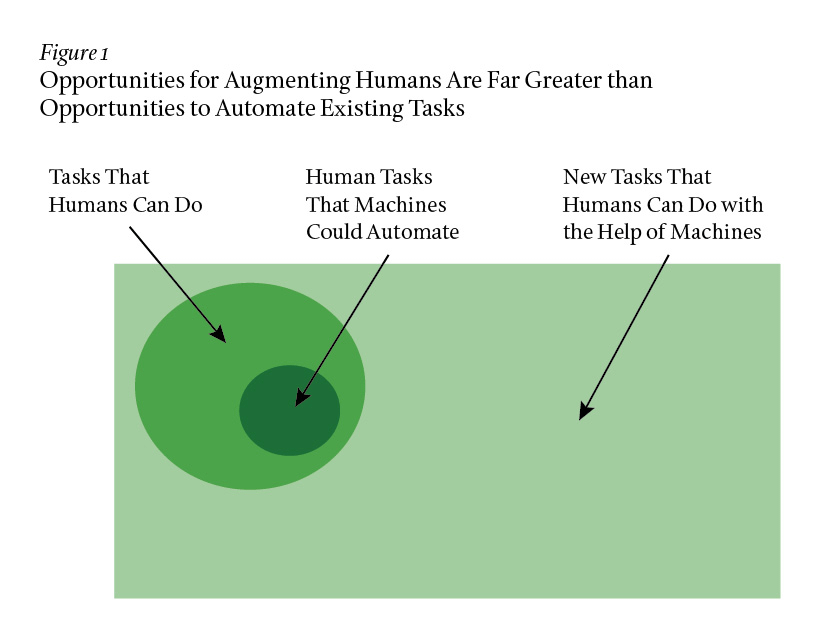
Productivity has a tidy equation: output over time. It works when you’re comparing the same task done two ways, yet augmented work has no before. A solo consultant matching McKinsey on research depth. A one-person team shipping what used to need five. Neither is old work done faster. It’s a different category of output with nothing to divide by. The metric breaks down exactly where the most interesting work is happening. My instinct is the right question isn’t “how much faster” but “what’s now possible that wasn’t” as Erik Brynjolfsson refers to as the way to exit the “Turing Trap” (visual above).
If any of this resonates, or if you’re seeing something different, I’d like to hear about it. This is a live conversation, not a final word.
Thanks,
Research references:
My open repository is here (and has 30+ sources as of today).
The papers mentioned specifically here are:
Peng, Kalliamvakou, Cihon, Demirer, “The Impact of AI on Developer Productivity: Evidence from GitHub Copilot” (Microsoft / GitHub / MIT Sloan, arXiv 2302.06590, Feb 2023).
Dell’Acqua, McFowland, Mollick, Lifshitz-Assaf, Kellogg, Rajendran, Krayer, Candelon, Lakhani, “Navigating the Jagged Technological Frontier” (Harvard Business School / Wharton / MIT Sloan / BCG, Organization Science, 2026).
Dell’Acqua, Ayoubi, Lifshitz, Sadun, Mollick, et al., “The Cybernetic Teammate” (Harvard Business School / Procter & Gamble, NBER Working Paper 33641, March 2025).
Shen, Tamkin, “How AI Impacts Skill Formation” (Anthropic Fellows Program, arXiv 2601.20245, Jan 2026).
Barcaui, “ChatGPT as a Cognitive Crutch” (UFRJ, Social Sciences and Humanities Open, Nov 2025).
Shaw, Nave, “Thinking Fast, Slow and Artificial” (Wharton School, PsyArXiv, Jan 2026).
Dell’Acqua, “Falling Asleep at the Wheel” (Harvard Business School working paper, 2022).
Kosmyna, Hauptmann, Yuan, Situ, Liao, Beresnitzky, Braunstein, Maes, “Your Brain on ChatGPT” (MIT Media Lab, arXiv 2506.08872, June 2025).
Sharma, McCain, Douglas, Duvenaud, “Who’s in Charge? Disempowerment Patterns in Real-World LLM Usage” (Anthropic / University of Toronto, arXiv 2601.19062, Jan 2026).
Cheng, Lee, Khadpe, Yu, Han, Jurafsky, “Sycophantic AI Decreases Prosocial Intentions and Promotes Dependence” (Stanford University, arXiv 2510.01395, Oct 2025; published in Science, 2026).
It resonates a lot. So much.
Thanks for writing it.